
Now that you’re married, you’ll likely be filing taxes as MFJ, also known as Married Filing Jointly. Because you’re now married and filing taxes jointly, you’re both now subject as a unit to a different set of tax brackets, income limits, and contribution limits, even if you don’t merge your day-to-day finances. These differences may result in changes to your optimal retirement contributions strategy as a couple and create some planning opportunities for you.
[Note that while there’s also a “Married Filing Separately” tax filing status, there are certain tax penalties associated with filing that way and is in general not something to consider without guidance.]
A Tax Primer
Income taxes are essentially what we owe the government for being citizens, and while you may have taxes withheld throughout the year by your employer, or you might make estimated tax payments throughout the year, they are reconciled every April for the previous calendar year.
Now that you’re married, you can no longer file as single at all—that’s just not even an option. And the IRS considers you married for the entire year in which you became married. So even if you don’t get married until December 31 of a given year, you’re still considered as having been married for that whole year in the eyes of the IRS.
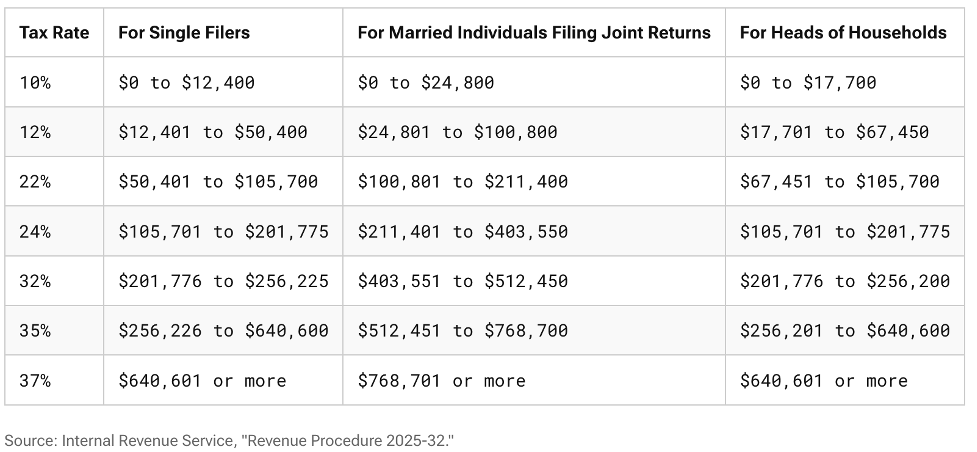
2026 Federal Tax Brackets.
Let’s look at an example of a married couple filing jointly. On the first $24,800 of income for 2026, the household is taxed at 10%, while the next chunk of income up to $100,800 in income is taxed at a slightly higher 12% rate. This is why the tax system in the US is called progressive: While you’re never taxed twice, the more money you make, the more tax you’ll pay on those higher income levels. So a household making $150,000/year (say between two earners of $75,000 each) has some of the income taxed at 10%, some at 12%, and the final chunk up to $150,000 at 22%. This means that your marginal tax rate is 22%, depending on the state you live in.
Consider, then, that most couples with two equal incomes typically have no tax benefit or penalty for getting married. It may definitely feel different to each of you, though, depending on what your incomes are exactly.
Since your employer knows what you make throughout the entire year, they calculate the average tax rate of all of the tax brackets and withhold that from your paycheck, which helps make your paychecks more even and predictable.
Calculating your marginal (top) tax rate:
Identify your total household income in the appropriate column on this table. The appropriate column depends on whether you and your partner are married.
Write down the associated tax rate. This is your top federal tax bracket.
Identify your state’s tax rate. This may be a flat rate or a progressive rate depending on your state.
Add your federal top tax rate and your state’s income tax rate. This is your marginal tax bracket. (Note that this is different from your effective, or average, tax rate.)
Examples
Diana and Lauren: These two both make $75,000/year as nurses in Massachusetts and are getting married next year. Right now they are each individually in the middle of the 22% federal tax bracket for single filers. They also both pay state income tax of 5%. Each of their marginal tax rates today is 27%. Each of their average tax rates is about 15.5% (not including Medicare or Social Security). When they get married, they will now together be in the middle of the 22% federal tax bracket for married couples filing jointly. Their marginal tax rate is still 27%, and their average tax rate is still about 15.5% (again not including Medicare or Social Security).
Kira and John: They are a couple living in Nebraska, also engaged. Kira currently makes about $250,000 as a product manager, while John makes $65,000 as an electrician. Kira is right at the top of the 32% federal tax bracket and also pays a 5.84% state income tax (Nebraska’s state income tax is also progressive). Her marginal tax rate is then 37.84%, while her average tax rate is 26.6%. John is currently in the 22% federal tax bracket and also 5.84% state tax bracket, for a total marginal tax bracket of 27.84%. His current average tax rate is about 13.5% because most of his income is taxed at a lower federal rate. When they get married and their total household income is now $315,000 and they are filing jointly, they will now be in the middle of the federal 24% bracket and 5.84% state tax rate. Their new average tax rate will be 22.4%, not counting Social Security or Medicare taxes.
My husband and I: We got married in September, and so when the following April came and it was time to file taxes, we filed as married filing jointly for that previous year even though we were only married for four months of that tax year. We also received a larger tax refund than expected because of the tax bracket change (since we hadn’t made any withholding adjustments until September when we married). We had our employers withholding from each of our salaries at a single rate from January through August, which is a higher, more expensive tax rate than the married filing joint rates. If we had adjusted our withholding to married filing jointly in January while still engaged, we would have had less money in taxes withheld from our paychecks and been able to use more money up front. For us, married filing jointly did save us money on taxes because at the time he was a grad student with fairly low income and I was working in tech, so our incomes were different.
I use this as a prime example to illustrate how you should theoretically consider making your withholding and retirement contribution adjustments at the beginning of the year you get married.
For You and Your Partner
Calculate your marginal top tax rate and answer the following questions:
● Evaluate your new total income together (regardless of which accounts it flows into).
● Which marginal (top) tax bracket do you now fall into? Are you in a relatively high top tax bracket or a low tax bracket?
● How does this new married tax bracket compare to your previous single tax bracket?
Optimizing Taxes Now That You’re Married
One of the biggest ways to optimize your taxes is through retirement account contributions. Which retirement accounts are you currently contributing to, and with what tax flavor, as I like to call it? Do these need to change?
There are two main tax flavors to consider here, and a bonus third:
● Pre-tax: Your contributions to pre-tax accounts lower your income at the time of contribution, and you pay taxes on these accounts much later when it’s taken out during retirement. Examples would be a traditional IRA (if you’re below the income contribution limits) or a traditional 401(k).
● Roth: Your contributions to Roth accounts don’t lower your income at the time of contribution, but you don’t pay any more taxes on money in these accounts, including when you take money out. These accounts could include a Roth 401(k) or a Roth IRA.
● After-tax: These types of contributions only exist for you if your employer allows these kinds of contributions to their 401(k) plan. While the after-tax contributions to a 401(k) account are indeed after tax, the earnings on these contributions are considered pre-tax.
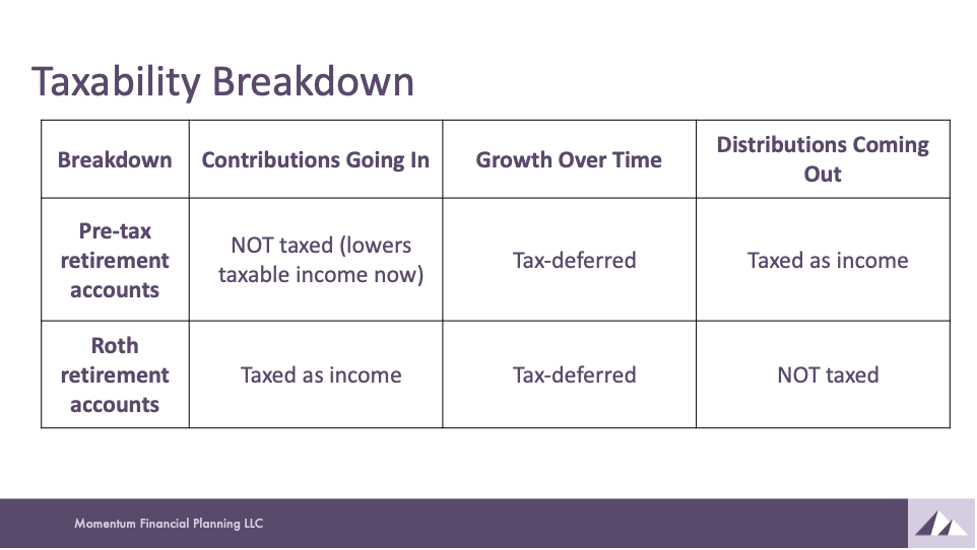
Taxability breakdown of different retirement accounts
Should You Pay Taxes Now or Later?
In general, I think of taxes and retirement like Now and Laters (my favorite candy, as it so happens). Being in a higher top tax rate now means that contributing more to retirement on a pre-tax basis is likely more advantageous than Roth-style; whereas, relatively low top tax rates now mean that contributing more to retirement accounts via Roth-style (regardless of 401(k) or IRA container) could be more advantageous.
Now we don’t know what will happen with the future tax rates that Congress will set, or with your income year to year, especially your income far off in retirement, but we can make educated guesses. Relatively early in your career, you might be making less money than you will in the future, or you might get a windfall from a big sale of company stock that might create a relatively high income year for you compared to other years.
Remember our retirement account income limits and contribution limits as well. For example, are you now each eligible to contribute to a Roth IRA? Or are you no longer eligible? Does contributing to a Roth IRA even make sense for you now? For example, a lower-income partner previously contributing to a Roth IRA may want to switch to pre-tax 401(k) retirement savings if the other partner has a larger income, which puts you both now in a higher tax bracket. (And in some cases, they may no longer even be eligible to contribute to a Roth IRA directly. They may have to consider a backdoor Roth IRA instead, which we won’t go into here.)
Spousal IRAs are also something to consider. Even if your spouse doesn’t have earned income (for example, a stay-at-home parent), they are still entitled to put money into an IRA (although this is phased out at higher income levels). One consideration is to discuss if you both are okay taking this “one economic unit” approach to put more toward your retirement, regardless of whose name the account is in. Are you fine with putting more into someone’s name who doesn’t have an income? In general, it makes sense to do so if you’re eligible, and I actively encourage it, but I realize that emotionally it may be another story depending on where you both are in your merging money journey.
Consider these opportunities if your incomes are unequal (let’s take advantage):
Higher-earning partner: moving from a high single income → lower (relatively speaking) married income:
● Consider pushing income out to when you’re now married.
● Consider maximizing pre-tax retirement contributions in years before getting married, then switching retirement contributions from pre-tax to Roth (including backdoor Roth IRA if needed).
● Maximize any spousal IRA opportunities for lower-earning partner when married.
Or this scenario: low single income → higher (relatively speaking) married income (for the lower-earning partner).
● Maximize Roth contributions in years before getting married, then consider switching to pre-tax style contributions in year of marriage.
● Maximize spousal IRA opportunities when married.
These are just a starting point for you and your partner to consider. If you’re looking for more financial advice, check out what services and programs Momentum offers or schedule a free intro chat with Sarah!