
Creating Your Balance Sheet As A Couple
While your entire financial life includes so many moving pieces, such as insurance protection, investing strategy, estate planning goals, and so forth, the heart and soul of your financial life is your basic money picture.
This basic money picture is made of two parts: the snapshot or balance sheet, and money in/money out or cash flow. Understanding this money picture is the first step toward getting a handle on your finances and determining your best steps forward together. The rest of your conversations with each other will assume a basic understanding of this money picture for yourself and each other.
Your basic money picture consists of your personal balance sheet and your cash flow over time. But what do I mean by balance sheet and cash flow? These are two key pieces of your financial life to understand. You can think of your balance sheet like a bucket that holds money, and your cash flow is both the faucet pouring water into the bucket as well as a hole in the same bucket that lets some of the money out.
Balance Sheet
Let’s start with your balance sheet. At any single point in time, you can take stock of how much money you have and how much you owe by putting together your personal balance sheet. Your personal balance sheet lists all your assets (what you own) and liabilities (debts you owe), and nets them out to arrive at your net worth with simple math.
[SUM OF ASSETS] MINUS [SUM OF LIABILITIES] = PERSONAL NET WORTH
The general goal of personal finance is to strengthen your balance sheet and build net worth over time in a way that accomplishes your goals and retirement/stability over time. Please don’t worry if your net worth today is not where you might like it to be. I wouldn’t read into it any more than this: Everyone’s net worth is relative and what matters is how yours changes for you over time. In general, if you’re doing everything financially right, updating your personal balance sheet and checking your net worth can be your quarterly or annual sanity check to make sure your finances are going in the right direction: up. This first net worth number is just your starting point.
Create Your Own
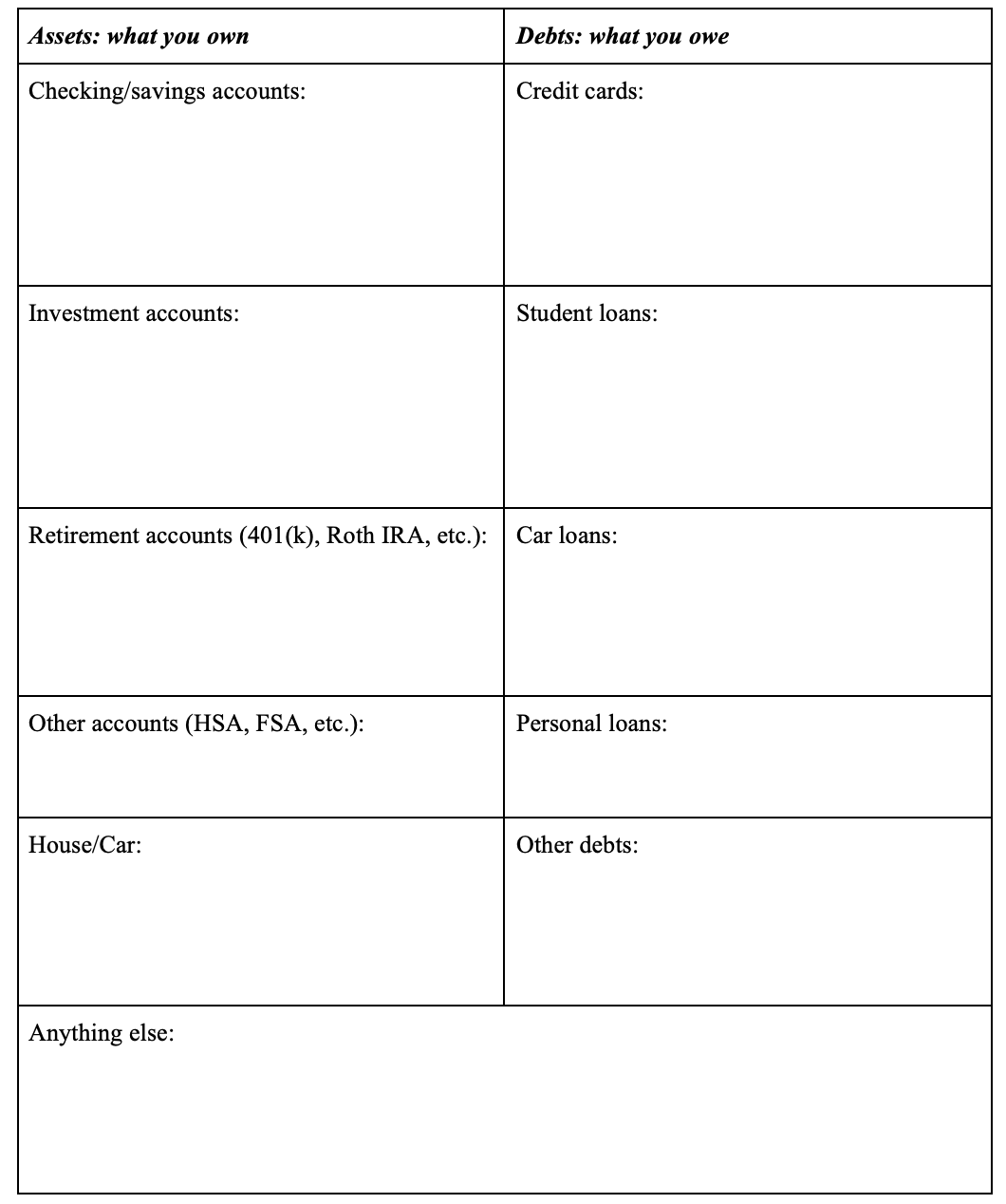
Example balance sheet template.
You can fill out this example balance sheet template with your partner. How does it all look together in one place?
Starting with your Assets: What You Own
To create your own personal balance sheet, let’s start with your assets. Your assets are all the different accounts and property that you own, from your checking account to your retirement accounts to your house. Each category of accounts is separated into its group and included for a reason.
First, let’s list your checking and savings accounts. These accounts hold cash that is ready for use at any time, such as regular day-to-day spending or larger unexpected expenses that may come up. In that section of your balance sheet, list each account name and balance, along with the interest rate on the account (if you can find it). For example, Wells Fargo Checking, $3,423 (0.01% APR) or Marcus Savings, $21,252 (3.8% APR). If you can’t find one or a piece of information about it, don’t worry, just mark it down anyway and come back to it. The goal here is to include all checking and savings accounts you have.
Now let’s move to retirement and other investment accounts. These are accounts from your current employer, previous employers, your business, or yourself. They include 401(k) accounts (including those from past employers), IRAs, brokerage accounts, and so on. Again, in the applicable section of your balance sheet, list these accounts for yourself. Examples here look like this: Acorns, $1,435, Fidelity Brokerage, $10,117, Vanguard Roth IRA, $4,555, Empower 401(k) Company A, $72,849.
Those accounts are the big ones to include, and we now likely have most of the accounts in your financial life included. If you own a house, be sure to include that. You can also include the current market value of your cars if you like too.
This is a bit of a controversial perspective because cars are depreciating assets, so their value will go down over time, even as you’re paying down any financing. But as long as you keep an accurate estimate of its worth, then you’ll at least know what’s realistic pricing to sell it someday and can go from there. You can get fairly accurate estimates from the websites of Kelley Blue Book, Carmax, and Carvana for vehicles and Trulia, Zillow, and realtor.com for houses. Just make sure to include any corresponding mortgage or car loan in the debts section too.
Take a moment to add up these balances. This number is the total value of your assets. You’re halfway to a completed balance sheet.
Next Up: Liabilities (What You Owe)
Now on to liabilities. These are all your debts—people and institutions to whom you owe money. Start with credit cards. Do include the balances here even if you pay them off, just to be thorough. You can list all credit cards individually, their interest rates they charge you, and any other information as well such as promotional periods ending. Examples here would be like Synchrony card 1234, $3,245 (pay in full each month) or Chase credit 5678, $8,218 (0% APR until July 2028).
Next let’s move to other types of debt. This could include mortgages, student loans, personal loans, loans from family/friends, car loans, tax debt, or anything else that you own or owe. Make sure to note important pieces of information like interest rates, payments, or other terms for each one.
If you don’t know something, that’s okay. Just mark it down and move on so you can come back later. Examples here could be federal student loans, $24,878 (interest rates between 4 and 6.5% or loan from parents, $10,922 (2% interest rate)).
Now you almost have your balance sheet completed. Let’s just calculate your net worth and then move on. Once again, your net worth is equal to the sum of your assets minus the sum of your liabilities:
[SUM OF ASSETS] MINUS [SUM OF LIABILITIES] = PERSONAL NET WORTH
You’re Done! You Have Created Your Balance Sheet!
Personal net worth is your overall number to keep track of, and its general direction (hopefully upward) can indicate your overall financial health. You can now calculate your total assets, total liabilities, and net worth.
Once you’ve done that, take a moment to reflect. How does this net worth number feel? High? Low? Do you owe more than you have? Have you seen it before all the time or never before? How does it feel to have everything in one place together? Whether it’s the first time you are seeing all these accounts in one place or your thousandth, you now have an organized financial starting point all in one place.
Looking for more financial advice? Check out what services and programs Momentum offers or schedule a free intro chat with Sarah!